
Where history lives: the story of Patryce Loftin
Patryce Loftin’s life story is deeply intertwined with the history and rhythms of Fairmount, Indiana. Spanning generations, her memories carry family history back to the Civil War, a childhood shaped by farm life, close-knit relatives, music, and local schools, and a lifelong commitment to learning and teaching. Though her journey took her far beyond Indiana—to Europe and many years in the Deep South—Fairmount remained the place that continually called her home.
Through restoring her family’s historic farmhouse, welcoming visitors from around the world, educating students, and serving the town through civic and volunteer leadership, Patryce has played a quiet but meaningful role in preserving Fairmount’s past while nurturing its present. What follows is her story—but it is also the story of a town where history lives through people, homes, and the generations who continue to gather there. Her story in her own words is below.
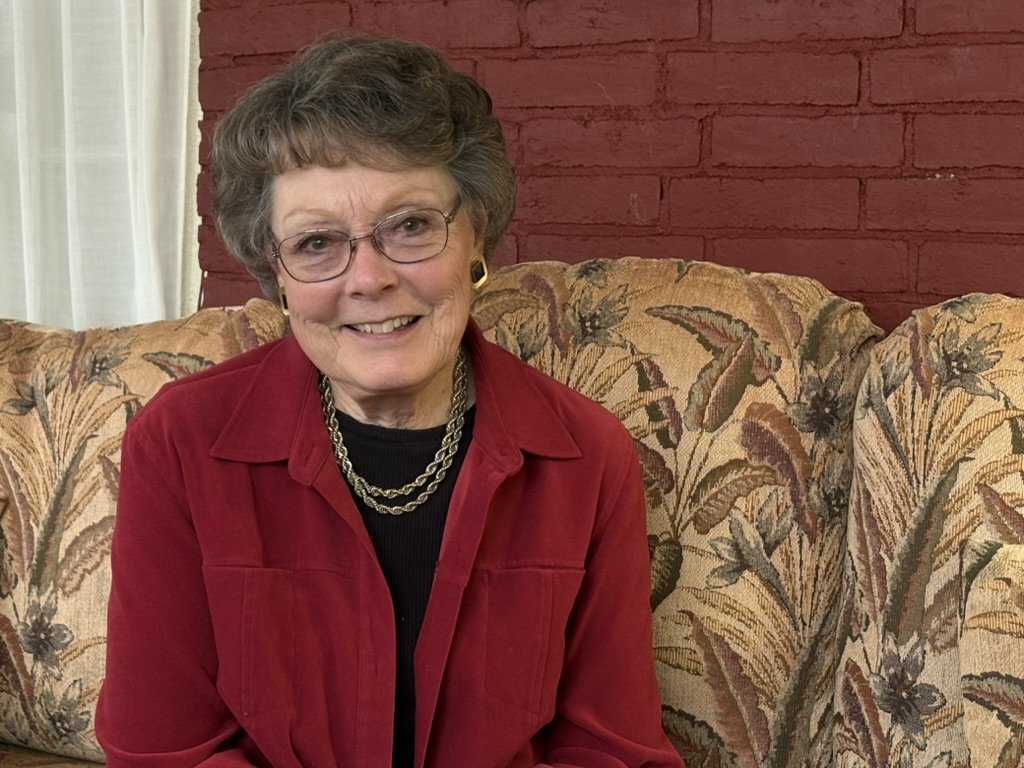
Fairmount isn’t just where I live—it’s where my story begins … long before I was born.
My great-grandfather stepped off a train here in 1870, an eighteen-year-old starting adult life with nothing but memory, grit, and a future he couldn’t yet imagine. As a boy during the Civil War, he had the job of hiding horses in the woods when armies came through—both Union and Confederate. They took whatever they needed. That part of history doesn’t always make it into textbooks.
He lived to be 93, long enough for me to know him, and to talk with him. I was 5 years old. Our family listened to him remember Abraham Lincoln’s assassination as if it had just happened.
That sense of living memory—of history not as dates, but as people—has shaped everything about my life in Fairmount.
I grew up on a farm two miles from where I live now. My parents met at Marion College—my mother became a registered nurse, my father a farmer. I attended West Ward Elementary and graduated from the old Fairmount High School on Vine Street in 1963, then from Marion College in 1967.
My extended family life was full and robust in the best way. My grandmother raised eight children in her 1860 Greek Revival brick home, and that meant cousins everywhere. We slid down the stairway banister, played indoors and out, and gathered often around big family dinners. That house wasn’t just a building—it was a living place.
Music entered my life early and never left. I started piano lessons at 8, earned a music degree, and later completed a master’s in music at Ball State. I performed often—competitions, church pianist and organist, weddings and funerals, even a high-school commencement. In college, playing a piano concerto remains one of my favorite memories.
Along the way, I studied speech with Mrs. Nall, James Dean’s famed teacher, and later returned to college to be able to teach English and speech, using many of her methods. Speech contests, memorized readings, and thoughtful table conversations were simply part of growing up in our house.
I was the oldest—and the only girl—with two younger brothers. Sadly, my youngest brother passed away during COVID. The other is retired after a life of farming and flight instruction.
After college, I began teaching in Wabash, Indiana, with two clear goals: earn my master’s degree and travel to Europe! At the time, Europe felt impossibly far away. Then a professor said something simple that changed everything: “You’ll never go until you decide to.”
So I decided.
One year paid off debt. One year bought a used car. The third year… I went! My cousin and I traveled through eleven countries in three weeks—castles, cathedrals, museums, landscapes, and the great Masters. That trip shaped my understanding of history and place. I’ve traveled to Germany several times now.
Life took an unexpected turn when I moved to Mobile, Alabama, to teach. At my first PTA meeting, I met Earl—there to check on his daughters. He was a widower; his wife and baby had died in a car accident. A later phone call about school matters turned into a long conversation, then another, and then everything changed.
Marrying Earl meant gaining a family overnight—two daughters and a son—and not long after, two more sons were born to complete our family.
Earl worked as maintenance supervisor for International Paper’s Mobile Mill, once the largest paper mill in the world, overseeing hundreds of employees. Mobile was home for 16 years—warm winters, the bay, the Gulf, a beautiful place. Family, church, and school were our priorities, along with a yearly trip to Fairmount.
Then my mother became ill with cancer. I returned to Fairmount to care for her, homeschooling one of my sons during that time. We rotated—six weeks here, then back to Mobile—until life shifted again. My grandmother passed away, Earl retired, and the family farm called us home.
My Grandmother’s 1860 farmhouse was showing some years of neglect when we moved in. We camped in it for five years—borrowed furniture, frozen water glasses, no heat upstairs—before beginning restoration. Eventually, I wrote a letter to Ball State’s School of Architecture with a photo and one word: “Help!”
They did.
That began my education in historic preservation—soft handmade brick that must stay painted, original windows and woodwork, light fixtures preserved. Students created floor plans. Indiana Historic Landmarks guided every decision. Slowly, carefully, the house came back to life.
During those years, a neighbor called about a couple from Wisconsin needing a place to stay during the James Dean Festival. At that time we barely had mouse holes plugged—but we said yes. Hosting them was such a wonderful experience that I told Earl, “Maybe someday this could be a bed and breakfast.”
So, it became one.
Running the B&B brought the world to us – literally! Because of James Dean, we hosted guests from across the globe – tourists, scholars, filmmakers, actors, and lifelong fans. They sat in our dining room drinking coffee, asking about the town, about Dean, about our lives. I was struck by how mutual the curiosity was. The house became a crossroads – history, community, and stories all under one roof. It was not uncommon to hear foreign languages spoken at my dining room table.
Along the way, we welcomed four foreign exchange students – two from Germany, one from Spain, and one from South Korea. I served on the Library Board, the School Board, and now the Fairmount Township Trustee and Mainstreet Fairmount Boards. Each role has brought me new lessons and deeper appreciation for the people who care for this town.
As always, the house and farm remain a gathering place—Now it is the laughter of the 5th, 6th, and 7th generations that can be heard. Interestingly, all are familiar with the stairway and its banister……